Lewis Ringer
The AxLewis Ringer is a community-college literature professor whose affair with June Ricks draws him into the investigation of her parents’ murders. Although he is publicly treated as the likely killer, the account reveals that the resemblance and circumstances pointing toward him conceal the actual murderer: Burke Devore. Ringer’s arrest, release, and death show how an accusation can harden into a convenient explanation without the evidence needed to prove it.
Identity and Introduction
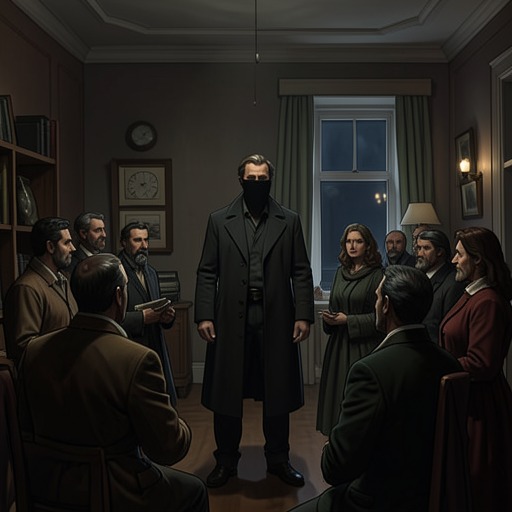
Ringer is introduced to Burke Devore through a televised news report showing a suspect being led from an office building on a community-college campus. He is a middle-aged, slope-shouldered man with a gray widow’s peak and large bifocals. He is not handcuffed, but state troopers surround him and guide him into a white state police car. The broadcast identifies him as a professor of literature and as the lover of June Ricks, the eighteen-year-old youngest child of Edward Ricks and Mrs. Ricks.
His resemblance to Burke is limited but consequential. Burke also wears large bifocals and has a gray widow’s peak; watching the report more closely, he sees little likeness beyond those details. Mrs. Ricks had mistaken Burke for Ringer, a misidentification that helps explain how suspicion can attach to the wrong man. Burke dismisses her judgment as foolish, while recognizing that the resemblance has made Ringer legible to the police and the public as the person who could have committed the murders.
The Murder Investigation
Ringer is accused of killing June’s parents, but the reader has already been told that Burke chased Mrs. Ricks across the lawn and shot her, then intercepted her husband in the garage and shot him. Burke left without witnesses or clues. The report’s portrayal of Ringer therefore creates a sharp divide between the apparent case and the truth available to the reader: the investigation has a suspect, but the televised account does not identify the actual killer.
The police believe Ringer is responsible from early in the investigation, yet they lack solid physical evidence. They know the weapon was a nine-millimeter gun but have not found it or identified the dealer who sold it. Authorities speculate that Ringer acquired it out of state with false identification and discarded it in a nearby river or lake. These remain assumptions, not demonstrated links between him and the killings. Without the gun or other physical evidence, the police have to release him on Saturday when his lawyer demands it. They continue watching his home around the clock, partly to keep the curious crowds away.
June Ricks and His Wife
The broadcast presents June as a secretive, sullen young woman, whose sidelong glances and flickering smiles strike Burke as signs that she is pleased by the upheaval surrounding her. He believes she cannot admit either that pleasure or her belief that Ringer killed her parents. Later, June tells reporters that she thinks Ringer murdered them for love of her: she believes he loved her but went too far. Her public account makes their relationship central to the suspected motive, while remaining an accusation rather than proof.
Ringer’s wife is also briefly shown in the news coverage, tear-stained and stunned in the doorway of their modest house as media gather on the lawn. She slams the door on them. After announcing on Friday evening that she would return to her parents in Ohio and begin divorce proceedings, she leaves the next morning. By the time Ringer returns home after his release, the house is empty. The separation gives the police a personal explanation for what follows, but it also means the account of Ringer’s final days is shaped by other people’s interpretations rather than by his own words.
Release and Death
Four days after Burke’s encounter with the Ricks household, he and Marjorie Devore hear on the Monday evening news that Ringer has hanged himself in his garage sometime the previous night. The report says the police consider the case effectively closed. Their theory is that Ringer, facing his wife’s departure, June’s public rejection, the police investigation, and knowledge of the crimes, could no longer face the world. The hanging takes place in the space where his wife’s car used to be, a concrete detail that joins the collapse of his marriage to the official explanation of his death without proving that explanation.
Burke watches the coverage and concludes that no one seems sorry Ringer is dead. In his view, the death makes the case easier for everyone and leaves less room for doubt: Ringer had been accused of killing his lover’s parents, and now he has killed himself. That apparent closure is deeply ironic. Burke knows the killings were his own, yet the police and public can accept Ringer’s death as the ending they need. Ringer consequently remains an unresolved figure in the investigation: not established as the murderer, but made into its convenient final answer.